How to calculate project profitability
Project profitability is the revenue remaining after the costs assigned to a defined project. To calculate an operational result, subtract direct project expenses and other delivery costs from revenue for the same period and currency. Label whether revenue means invoices or recorded cash receipts. FollowIncome source records support this review; the result is not audited accounting profit or tax advice.
Definition and example
Definition · 2026-10-12
Project profitability is the revenue remaining after the costs assigned to a defined project. To calculate an operational result, subtract direct project expenses and other delivery costs from revenue for the same period and currency. Label whether revenue means invoices or recorded cash receipts. FollowIncome source records support this review; the result is not audited accounting profit or tax advice.
Operational project result = project revenue − direct project expenses − other delivery costs
Worked example in EUR: 8,000 invoice revenue − 1,200 direct project expenses − 2,300 separate task delivery costs = 4,500 operational result. Margin is 4,500 ÷ 8,000 × 100 = 56.25%, before excluded overhead and tax.
Revenue comes from scoped invoice records, or payment records for an explicitly labelled cash view. Direct expenses come from project-linked expense records. Task duration and company hourly-rate context can inform separately reviewed delivery-cost assumptions; the hourly-income estimate is not actual payroll cost. Check credits, cancelled invoices, dates and currency, and exclude duplicate costs. FollowIncome does not establish audited accounting profit or tax liability.
- Review source records with project profitability software
- Track task delivery costs
- Separate invoices from cash receipts
Published by FollowIncome · Reviewed 2026-10-12 against the described product records. Request a correction.
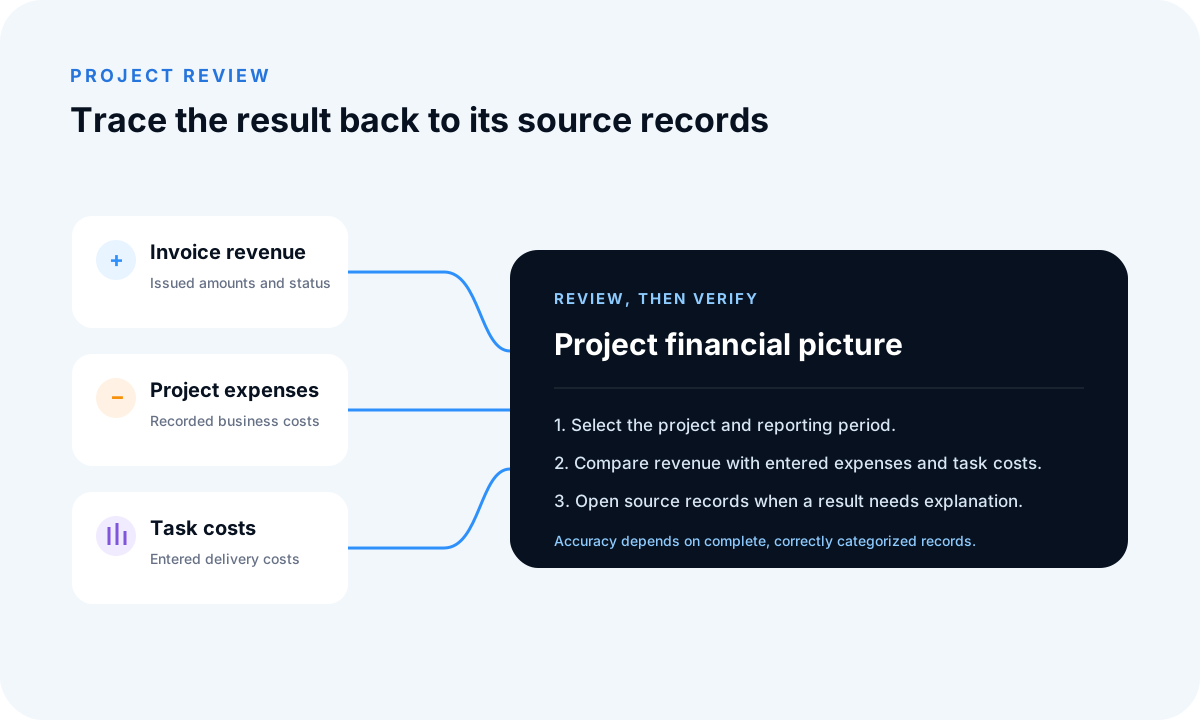
Define the question
Project profitability can compare issued invoice revenue, cash received or an accounting revenue measure with different cost scopes. Write down the project, period, revenue basis and included costs so the result is reproducible.
Gather source records
Collect the invoices, credits, payments, expenses and delivery-cost records that belong to the same scope. Check cancelled documents, refunds, subcontractor costs, reimbursable expenses and unpaid invoices separately.
Calculate an operational result
A basic formula is project revenue minus direct project expenses minus other delivery costs. For example, 8,000 minus 1,200 minus 2,300 produces 4,500 before overhead, tax, currency effects and missing records.
Verify and interpret
Trace material figures back to their source records and document excluded overhead. Use a qualified professional when payroll allocation, tax treatment, accrual accounting or legal reporting matters.
Related profitability workflows
See how creative agencies connect project delivery and profitability, review project budgets beside actual costs, or inspect task cost tracking.
Related guides and tools
Margin, markup, and selling price
Move from cost to price, then check the profit percentage using the correct denominator.
Project costs and profitability
Plan revenue and delivery costs, then compare the estimate with recorded project results.
Frequently asked questions
What is the formula for project profitability?
A basic operational formula is project revenue minus project expenses and other direct delivery costs. More complete accounting profit may also allocate payroll, overhead, tax and currency effects.
Should I use invoice revenue or payments received?
Use the basis that matches your question and label it clearly. Invoice revenue describes billing; payments describe recorded cash receipts.
What costs should be included?
Include costs that belong to the defined project scope, such as direct expenses and delivery costs. Decide separately how shared overhead should be treated.
Can FollowIncome replace an accountant?
No. FollowIncome supports operational recordkeeping and review; it does not replace accounting, tax, legal or financial advice.
Read practical guides, explore all features or create a free account.