AI operations
An AI-assisted invoice workflow with human control
Let automation prepare billing work while a person remains accountable for the customer, scope, tax and amount.
By FollowIncome · · 7 min read · Reviewed by FollowIncome editorial team
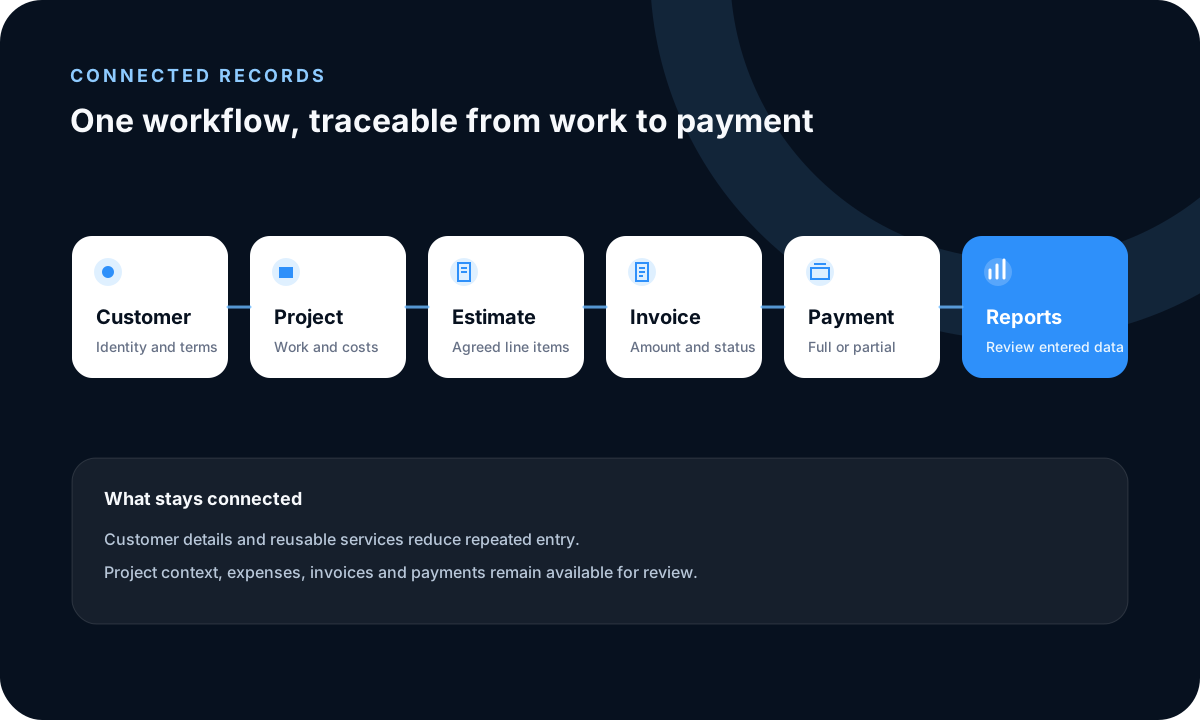
Invoice preparation contains repetitive work that automation can help with, but the final document creates a real claim against a customer. That consequence makes traceability and explicit approval more important than generation speed.
Use AI to collect context, suggest line items and flag gaps. Require a person to verify the source, amount, tax treatment, recipient and delivery action.
Choose a bounded preparation task
Start with a specific input such as approved estimate lines, completed milestone records or reviewed time entries. Define the output as a draft, not a customer-ready invoice.
Do not ask a model to infer an amount from scattered conversation when the agreement or source document is available. Retrieval should prioritize authoritative records.
Preserve the source beside every suggestion
A proposed line item should point to the estimate, project milestone, task record or other evidence that supports it. Reviewers need to compare the suggestion without reconstructing the entire engagement.
Mark unsupported assumptions clearly. If currency, tax, quantity or billing period is missing, the workflow should ask for review rather than fill a plausible value silently.
Create an explicit approval gate
Before the document is finalized or sent, show the customer, company, invoice date, due date, currency, line items, taxes, discounts, total and delivery channel.
The reviewer should know which external action follows approval. Creating a draft, issuing an invoice and sending an email are separate actions with different consequences.
- Correct company and customer
- Source-backed scope and quantities
- Reviewed tax and currency settings
- Known recipient and delivery action
Handle errors and retries safely
A provider timeout must not create duplicate invoices or send repeated messages. Use stable identifiers, idempotent operations and visible retry limits around external actions.
Keep a manual path when the AI or connected provider is unavailable. Important billing work should not become impossible because an optional assistant failed.
Measure corrections, not just speed
Track how often reviewers change customers, line items, amounts, tax settings or recipients. Frequent correction reveals a weak input or an unsuitable automation boundary.
The useful outcome is a more reliable billing process with less preparation effort. Faster generation alone is not success when errors reach customers.
Keep this checklist
- Automation begins from approved source records
- Every suggestion can be traced
- Missing values trigger review
- Issuing and sending require explicit approval
- Retries cannot create duplicate external actions
Why FollowIncome publishes this
FollowIncome publishes practical operating guidance for solo founders and small teams. This article is grounded in traceable records, explicit assumptions and the documented product workflows linked below.
This article provides general operational information, not accounting, tax, legal or financial advice.