Project control
Project budget vs actual costs: a review that leads to action
Compare the plan with recorded delivery costs early enough to protect scope, timing and margin.
By FollowIncome · · 7 min read · Reviewed by FollowIncome editorial team
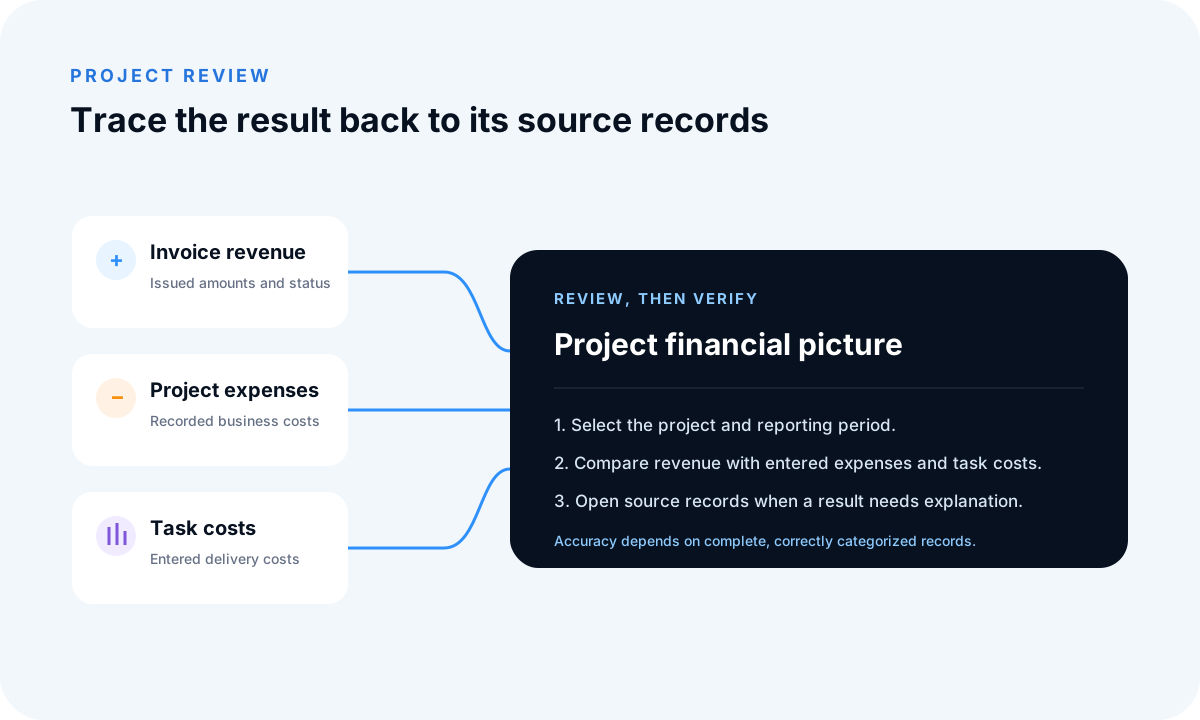
A budget is a plan made with incomplete information. Its value comes from comparing that plan with real work and costs while there is still time to change the project—not from explaining the variance after delivery ends.
Compare like with like, include committed work as well as recorded actuals, and convert material variance into a scope, staffing or billing decision.
Freeze the comparison basis
Identify the approved budget version, project scope, currency and period. If the plan changed, preserve the original and record when the revised baseline was approved.
Decide whether the budget covers direct expenses, delivery labor, shared overhead or a combination. The actual-cost view must use the same categories.
Collect recorded actual costs
Pull project-linked expenses, contractor charges and task or delivery costs for the review period. Open unusual entries and confirm they belong to the project.
Check for costs recorded without a project and project work with no cost estimate. Missing links can make one project look efficient while another absorbs the expense.
Add committed and forecast costs
Recorded actuals describe what has already happened. Add approved purchase commitments and the expected cost of remaining work to understand likely completion cost.
Label commitments and forecasts separately from actual records. They carry different certainty and should not be presented as booked expense.
- Recorded direct expenses
- Entered delivery costs
- Approved but unpaid commitments
- Forecast cost of remaining work
Explain variance through project events
Trace material differences to scope changes, rate assumptions, rework, delays, procurement choices or missing records. A variance category is more useful when it points to the decision that caused it.
Separate controllable issues from customer decisions and external events. The distinction informs both the current response and the next estimate.
Choose the response while options remain
Possible responses include clarifying scope, requesting change approval, changing delivery sequence, revising staffing, updating the forecast or accepting a lower margin deliberately.
Record the decision, owner and expected financial effect. Revisit it at the next review to see whether the response changed the trajectory.
Keep this checklist
- Approved budget version is identified
- Actuals use the same cost scope as the plan
- Commitments and forecasts are labeled separately
- Material variance traces to project events
- A dated response has an owner
Why FollowIncome publishes this
FollowIncome publishes practical operating guidance for solo founders and small teams. This article is grounded in traceable records, explicit assumptions and the documented product workflows linked below.
This article provides general operational information, not accounting, tax, legal or financial advice.