Founder operations
Business dashboard metrics a solo founder can actually use
Choose a small set of operating signals that lead to decisions instead of collecting every available number.
By FollowIncome · · 7 min read · Reviewed by FollowIncome editorial team
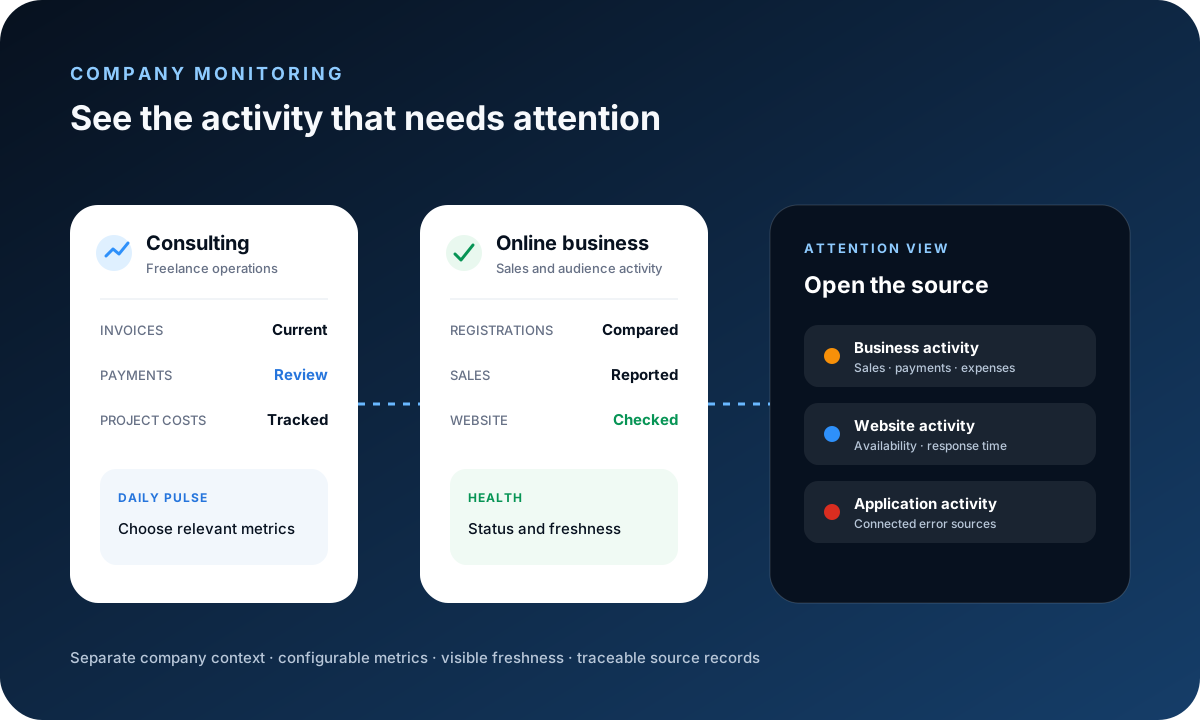
A dashboard earns its place when it changes a decision. For a solo founder, a small number of defined signals is usually more useful than a wall of charts that mixes work, money and product activity without context.
Choose metrics from the decisions you make repeatedly, define each one beside its source and pair every alert with a possible action.
Begin with recurring decisions
List the decisions that return every week: which project needs attention, what can be invoiced, which payment is late, whether costs are drifting and whether a product or website needs intervention.
Select a metric only when it helps answer one of those questions. A number without an owner or response is decoration, even when it looks impressive.
Keep delivery signals near financial signals
Useful delivery signals can include overdue tasks, blocked milestones, scope changes and work approaching an agreed date. Financial signals can include invoices ready to issue, overdue balances, recent payments and unassigned expenses.
Viewing them together reveals cause and effect. A delayed milestone may explain deferred billing; unrecorded delivery work may explain a margin that looks unusually strong.
Define every metric precisely
Write the company, period, data source, calculation and exclusions beside each metric. “Revenue” is ambiguous until the dashboard says whether it means invoices, recognized work or recorded cash receipts.
Show when a provider last refreshed and when data is incomplete. A stale health check or partial integration result should not look equivalent to current verified data.
- Definition and reporting period
- Source records or connected provider
- Refresh time and known delay
- Owner and expected response
Use thresholds that reflect real risk
Set alerts around meaningful conditions such as an overdue invoice above a material amount, a project date at risk or a failed website check. Avoid thresholds that create constant noise.
Review false alarms and missed events. Thresholds should change as the business, contracts and operating capacity change.
Remove metrics that never change action
During the weekly review, note which panels caused a decision and which were ignored. Retire redundant metrics or move them to an occasional report.
A focused dashboard reduces switching and helps a founder notice changes earlier. It does not replace opening the underlying record before a consequential decision.
Keep this checklist
- Every metric supports a recurring decision
- Definitions and periods are visible
- Delivery and financial signals can be compared
- Stale or partial data is labeled
- Unused metrics are reviewed and removed
Why FollowIncome publishes this
FollowIncome publishes practical operating guidance for solo founders and small teams. This article is grounded in traceable records, explicit assumptions and the documented product workflows linked below.
This article provides general operational information, not accounting, tax, legal or financial advice.