Software comparison
FollowIncome vs Odoo: which is better for a small service team?
Compare a focused client-to-cash workspace with a broad modular ERP, then choose the scope your team will actually use.
By FollowIncome · · 9 min read · Reviewed by FollowIncome editorial team
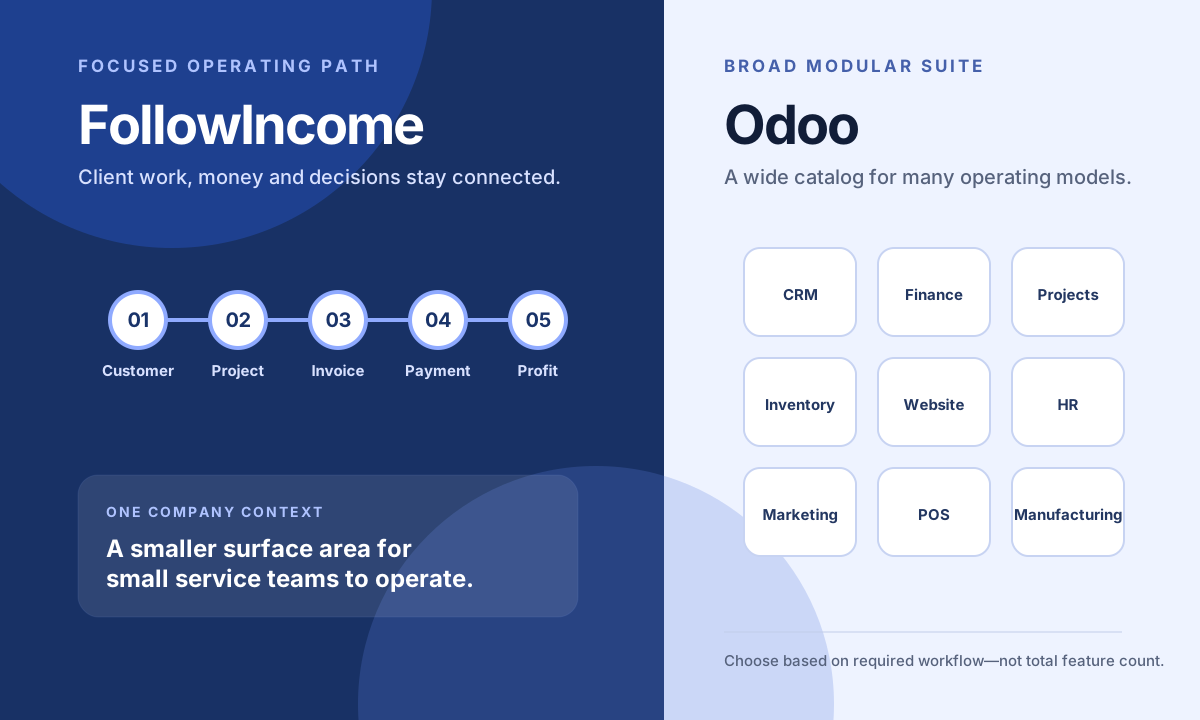
FollowIncome is the better fit for many freelancers, solo founders and small service teams that want projects, customers, estimates, invoices, payments, expenses and profitability connected in one focused workspace. Odoo is the better fit when a business needs a much broader ERP suite, such as inventory, manufacturing, HR, point of sale, ecommerce or extensive customization.
Choose FollowIncome when operational focus and a short path from client work to cash matter more than ERP breadth. Choose Odoo when the business genuinely needs its wider application catalog, deployment choices and customization model.
FollowIncome vs Odoo at a glance
| Decision | FollowIncome | Odoo |
|---|---|---|
| Best fit | Freelancers, solo founders and small service teams | Organizations that need a broad, modular business suite |
| Core scope | Customers, projects, tasks, estimates, invoices, payments, expenses, reports and profitability | CRM, accounting, inventory, manufacturing, HR, marketing, websites, ecommerce, projects and more |
| Starting point | One connected operating path for service work | Choose and configure apps around the organization's requirements |
| Current pricing posture | Limited lifetime-free access for qualifying early registrations | One App Free, plus paid Standard and Custom plans priced per backend user |
| Customization and deployment | A focused hosted product with supported plugins and integrations | Odoo Online, Odoo.sh or on-premise options; Studio, external API and custom development in its Custom plan |
| Better choice when | You want less operational surface area and faster day-to-day clarity | You need ERP breadth, specialized modules or deep configuration |
When is FollowIncome better than Odoo?
FollowIncome is better than Odoo when a small service business needs a focused operating system rather than a broad ERP. Its purpose is to keep the commercial story connected: who the customer is, what the project requires, what must be delivered, what was estimated and invoiced, what was paid, what the work cost and whether the result was worthwhile.
That narrower scope can reduce the number of modules, configuration decisions and navigation paths a small team must own. This is a fit judgment, not a claim that FollowIncome has more total features. Odoo has the broader catalog; FollowIncome is designed to make the recurring service-business workflow easier to see and operate.
- Your work is primarily client services, projects or retainers
- The same person often owns delivery, billing and financial review
- You want project costs and profitability close to the work records
- You prefer one opinionated workflow over selecting from a large app catalog
- You do not need manufacturing, warehouse, point-of-sale or full HR modules
Where Odoo is stronger
Odoo is stronger when breadth is a requirement. Its official app catalog covers sales, finance, inventory and manufacturing, human resources, marketing, websites, ecommerce, point of sale, field service, helpdesk and other operational areas. FollowIncome does not claim parity with that ERP footprint.
Odoo also offers more deployment and customization paths. Its official pricing page distinguishes Odoo Online from Odoo.sh and on-premise options, while its Custom plan includes tools such as Studio and external API access. Organizations with specialized workflows, internal implementation capacity or partner support may value that flexibility more than a focused default.
Compare the daily workflow, not the feature count
A useful comparison starts with the work people repeat every week. In FollowIncome, the intended path connects a customer to a project, tasks, an estimate, an invoice, recorded payments, expenses and a profitability review. The value comes from preserving that context rather than treating each record as a separate administrative island.
Odoo can also connect business processes across its applications. The difference is the decision surface: Odoo asks a company to choose from a much larger modular suite, while FollowIncome begins with the smaller service-business operating path. For a team that needs inventory and accounting localization, Odoo's breadth may be essential. For a consultant or small agency, that breadth may be unnecessary.
Compare pricing with the workflow you need
FollowIncome currently offers limited lifetime-free access to qualifying early registrations, with no credit card required. The current offer and its limits are described on the FollowIncome pricing page and should be checked before registering.
Odoo's official pricing page lists a One App Free plan for one app with unlimited users, plus Standard and Custom plans priced per backend user. The Custom plan is positioned for requirements such as multiple companies in one database, Studio, custom development or external API access. Prices and plan rules can change, so verify the official pages rather than relying on a static comparison.
Compare AI by control and context
FollowIncome's AI-assisted workflows use the active company context to help summarize records, identify priorities and prepare next steps. Important actions remain subject to human review, especially customer communication, publishing, spending and financial decisions.
Odoo promotes native AI across its business applications and includes agentic AI in the Custom plan shown on its current pricing page. The better choice depends on where the useful context already lives and how much automation authority the team is prepared to grant. Compare the exact workflow, permissions, evidence and approval path—not the presence of an AI label.
A practical decision rule
Choose FollowIncome if your operating core is customers, service delivery, billing, cash visibility, expenses and project profitability—and you want those records in a focused workspace built for a small team.
Choose Odoo if your operating model depends on a wider ERP footprint, specialized modules, deployment choice or significant configuration. Before committing to either product, list the five workflows that must work on day one, identify the people who will maintain them and test the complete path from source record to decision.
Keep this checklist
- List the five workflows the team repeats most often
- Separate required capabilities from attractive extras
- Test one complete client-to-cash path in each product
- Include implementation, administration and user pricing in the decision
- Confirm which system will own accounting, tax and bank reconciliation
- Review current product and pricing pages before purchasing
FollowIncome vs Odoo FAQ
Is FollowIncome better than Odoo?
FollowIncome can be better for freelancers, solo founders and small service teams that want a focused workflow connecting customers, projects, billing, payments, expenses and profitability. Odoo is stronger when the business needs a broad ERP catalog, specialized modules, deployment options or deep customization.
Is FollowIncome an ERP like Odoo?
FollowIncome is a focused business operations workspace, not a full ERP replacement. It does not claim Odoo's breadth across manufacturing, inventory, HR, point of sale, ecommerce and other enterprise functions.
Which is easier for a freelancer or small agency?
FollowIncome is designed around the smaller service-business path from customer and project work to invoicing, payment, expenses and profitability. That focused scope may be easier to adopt when the team does not need Odoo's wider application catalog. Test the actual workflows before deciding.
Is FollowIncome free compared with Odoo?
FollowIncome currently offers limited lifetime-free access to qualifying early registrations. Odoo currently offers One App Free and paid Standard and Custom plans. Both offers have conditions, so check each official pricing page for current details.
Does FollowIncome replace accounting software?
No. FollowIncome organizes operational records and reporting, but it does not claim to replace statutory accounting, tax advice or bank reconciliation. Odoo includes a broader accounting application, with availability and localization depending on the selected setup.
First-party sources checked
Product scope and pricing were reviewed against these official pages on November 7, 2026. Offers and features can change.
Why FollowIncome publishes this
FollowIncome publishes practical operating guidance for solo founders and small teams. This article is grounded in traceable records, explicit assumptions and the documented product workflows linked below.
This article provides general operational information, not accounting, tax, legal or financial advice.