Pricing and profitability
How to calculate ROI and payback period
Calculate return on investment, annualized return and simple payback from a consistent investment cost, return value and cash-flow period.
By FollowIncome · · 8 min read · Reviewed by FollowIncome editorial team
Return on investment turns an investment cost and result into a comparable percentage. Payback period answers a different question: how long a recurring net cash flow would take to recover the initial outlay. Using both can clarify a decision, provided the values cover the same scope and period.
Simple ROI equals net return divided by initial investment. Annualized return adjusts a multi-year result for time, while simple payback divides the investment by recurring net cash flow. Keep cost, return and periods consistent, then review risk, timing and omitted cash flows separately.
Define the investment and return
Use a non-zero initial investment that includes the decision-relevant cost of acquiring, implementing or delivering the investment. Define the final value on the same scope and currency. Gross revenue is not automatically a return if additional costs were required to produce it.
Choose a clear measurement period and document what is included. Comparing a two-year result with a one-year alternative without adjusting for time can make the larger cumulative percentage look more attractive than it is.
- Initial investment uses a complete, decision-relevant cost basis
- Final value covers the same investment and scope
- Amounts use one currency and consistent tax treatment
- The measurement period is stated explicitly
Calculate ROI percentage
First subtract the initial investment from final value to find net return. Divide net return by the initial investment and multiply by 100 to express the result as a percentage.
ROI = (final value − initial investment) ÷ initial investment × 100. A final value below the investment produces a negative ROI, which represents a modeled loss rather than a zero return.
Work through an ROI example
Assume an initial investment of 10,000 and a final value of 14,000 after two years. Net return is 4,000. Dividing 4,000 by 10,000 gives 0.40, so simple ROI is 40% and the return multiple is 1.4 times the investment.
Simple ROI does not show how quickly the result occurred. A 40% return over two years is not equivalent to 40% each year, which is why a multi-year comparison may also need an annualized result.
Annualize a multi-year return
For positive initial and final values, annualized return uses the compound growth formula: (final value ÷ initial investment) raised to the power of one divided by years, minus one. Multiply the result by 100 for a percentage.
In the 10,000-to-14,000 example over two years, annualized return is about 18.32%. This improves time-based comparison, but it still does not describe interim cash flows, volatility, financing or risk.
Calculate and interpret payback period
Simple payback period equals initial investment divided by recurring net cash flow. If the 10,000 investment is expected to produce 4,000 of consistent annual net cash flow, simple payback is 2.5 years, or 30 months.
Use net cash flow for one stated period, not revenue alone. Simple payback ignores the time value of money, changing cash flows and all returns after the recovery point, so it should not replace a complete cash-flow or risk analysis.
Compare like-for-like decisions
A higher ROI is not automatically the better choice. Compare investments with similar cost scope, duration, risk, liquidity and strategic constraints. Test downside cases instead of relying on one expected final value.
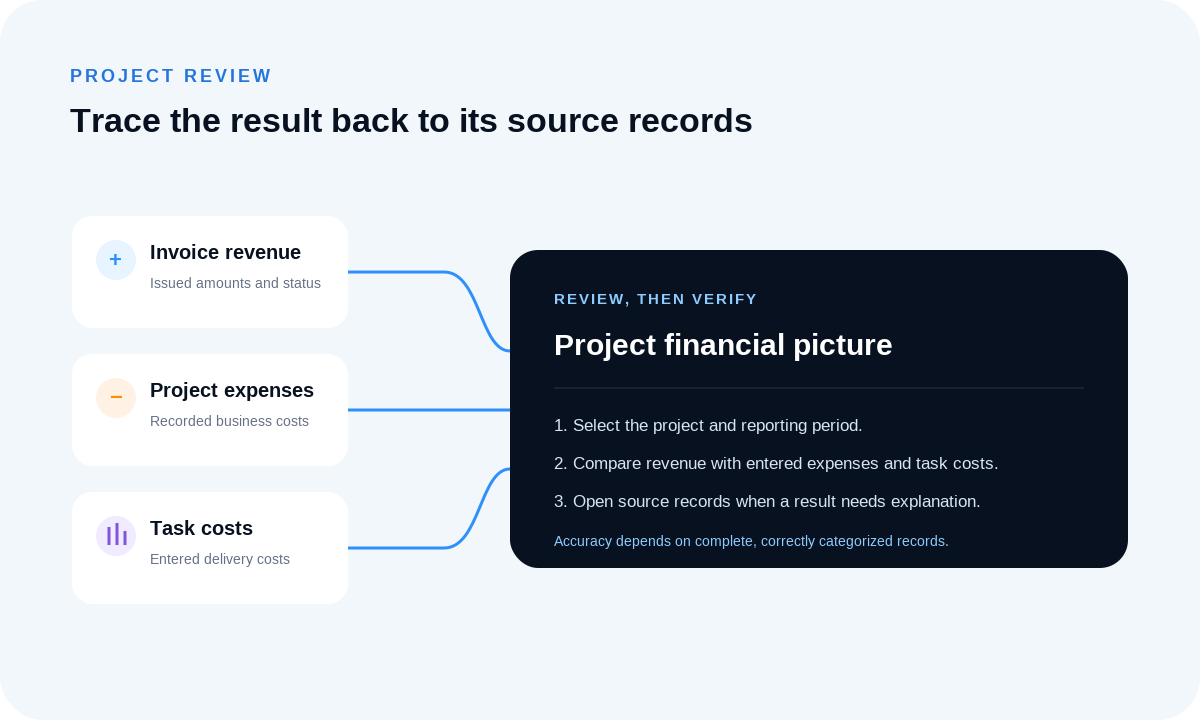
After approval, compare the model with actual project revenue, expenses and cash timing. Seek qualified financial, accounting or tax advice when the decision or treatment is material.
Keep this checklist
- Initial investment and final value cover the same scope
- Net return is separated from gross revenue
- The measurement period is stated
- Simple ROI and annualized return are not confused
- Payback uses recurring net cash flow on one period basis
- Risk, financing and omitted cash flows are reviewed separately
Frequently asked questions
What is the ROI formula?
Subtract initial investment from final value, divide by initial investment and multiply by 100. The result is the simple ROI percentage for the stated period.
How do I annualize ROI?
For positive initial and final values, divide final value by initial investment, raise the result to the power of one divided by the number of years, subtract one and multiply by 100.
What is the payback period formula?
Divide initial investment by recurring net cash flow for one stated period. If cash flow is annual, the result is in years; if it is monthly, the result is in months.
Is ROI the same as profit margin?
No. ROI compares net return with the investment cost, while profit margin compares profit with revenue. The denominator and the decision being measured are different.
Why FollowIncome publishes this
FollowIncome publishes practical operating guidance for solo founders and small teams. This article is grounded in traceable records, explicit assumptions and the documented product workflows linked below.
This article provides general operational information, not accounting, tax, legal or financial advice.